Dominic Michel is an artist and curator from Zurich.
River Shell is an artist and filmmaker living in Dallas, Texas.
They met several years ago in Bern, where Michel co-curated the exhibition space Riverside.
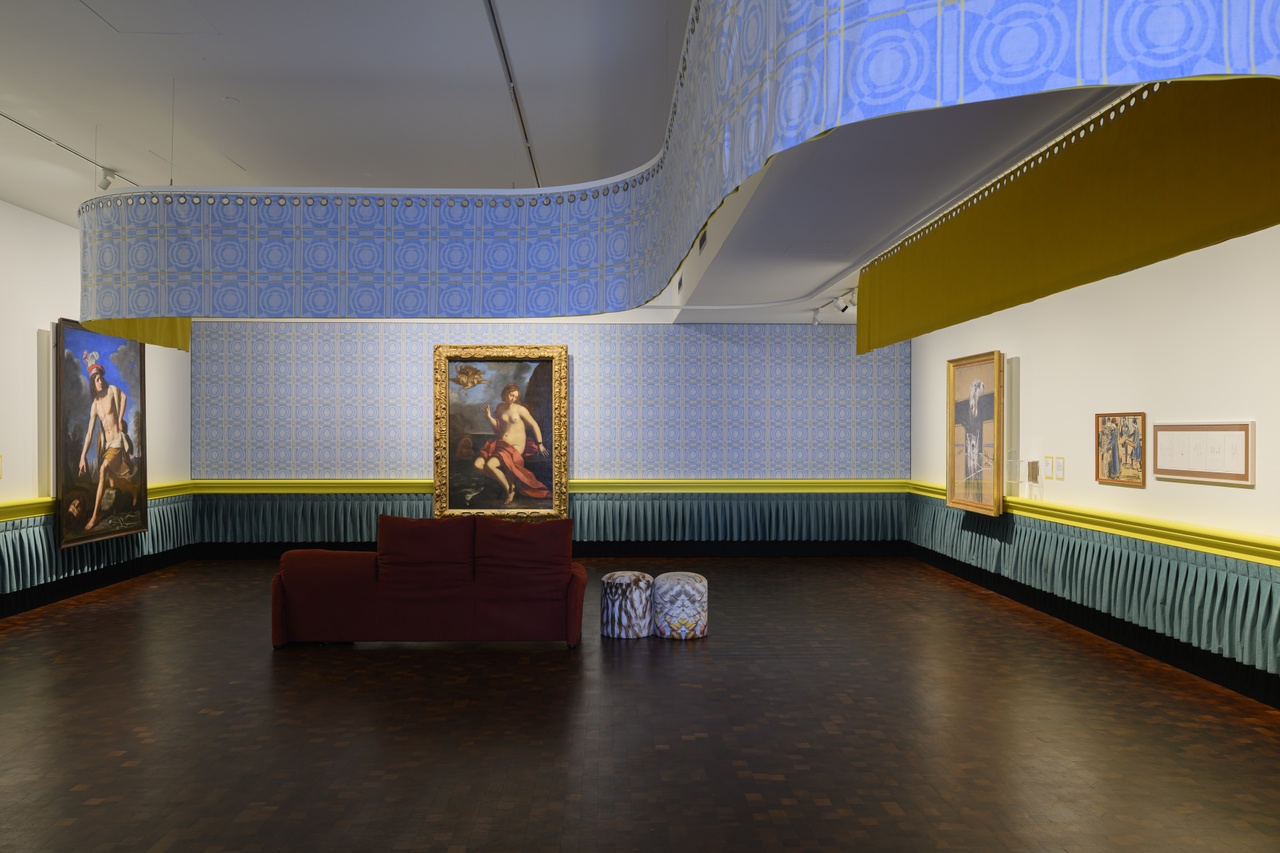
DM: We’ve known each other for quite some time now, since you were in Switzerland and took part in our exhibition Moon Ribbon at Riverside in Bern back in 2015. Do you remember that time?
RS: Yes, I do remember that time. Fondly. I loved meeting you guys and the time we spent together. All individually wonderful, welcoming people. I felt an instant camaraderie with you. I'm always surprised and honored that you still keep in touch and support my work. How do you feel about meeting each other in Switzerland? What do you remember from that period? Do you think we have something in common creatively?
DM: I think we have something in common in the sense that we both work within open structures, in collaborations, curatorial constellations among friends, and alone in the studio. That was also the case back in 2015: Mia, Andreas, and I organized Riverside, while you, Kris, and Gregory were around the area, and together with Tobias, Stefan, and Flavio we created that concert night. I feel like this jam somehow just kept unfolding between us. If I remember correctly, you later did a writing residency in the French-speaking part of Switzerland. Is that right?
RS: Yes, I did an artist residency in Trélex, at a château in the countryside. Really quiet. Mountains and cows. My Joan of Arc era. A lot of writing and madness.
DM: True, I remember that. We briefly met again in Bern during a surprise visit, and shortly afterwards there was an exhibition in Basel where I showed a poetry collection of yours. Did you continue working with that format afterwards?
RS: I used to be quite the confessional writer. A bit abstract, a little Beat and modernist, but recently my work's become more direct and I've been focusing on screenwriting. Writing is something that's always been with me, but it's coming out much differently now. Instead of vocalizing my emotions or romanticising my life, I just put it into the films now. It no longer feels like I'm giving myself away, but if you watch the films, I'm saying a lot about my feelings and philosophies. That shift fromlanguage into moving images somehow also connects to questions of collaboration and exchange; something that seems central to both of our practices.
RS: How do you feel about collaboration? It seems very important to you. How does it compare to working alone or curating?
DM: My artistic practice is concerned with mirroring and staging processes of mediated perception and visual construction. Many of the images, spaces, and objects I work with carry multiple meanings and functions simultaneously. I'm interested in how meanings, images, and emotional states shift through different people, contexts, and forms of collaboration; almost like a game of telephone, including its projections, misunderstandings and distortions. Collaboration, for me, emerges out of the moment rather than from something overly predetermined. It becomes an ongoing exchange of relationships, economies, and mutual dependencies. Often it begins through friendship and sometimes only manifests as a short snapshot of what was, a teaser for what might come, or simply a comment on what already exists. Many of the artists I work with also inhabit multiple roles at once. In that sense, a kind of symbiotic network forms, where collaborative, studio-based, and curatorial processes overlap. Different frequencies of the same tone. Last year, I organized a screening of films by you and Jake Elliott and set up a small video booth in Zurich where the works were shown on loop. Could you talk a bit about your collaboration with Jake?
RS: Jake Elliott and I have been collaborators for ten years this October. We have a joke that we have the same brain damage, so we just understand each other fairly quickly. We don't have to communicate that much to see what the other person is seeing. A lot of times we interpret something the other is trying to say. I kind of joke that the two of us make one good person, but we're also very independent of each other. We have some sort of creative telepathy that's fun to engage with for both of us, pulling things out of each other that force us to grow. We make music together and we make films together. He's the Anna Karina to my Godard. He stars in a lot of the things we make for DVD Films. Currently we're in pre- productionfor a film we wrote together and are creating an original score for. For us there will be more music, more films, and more collaborative work, whether that's exhibitions in a gallery or screenings in a cinema. I think we've officially known each other long enough to truly honor and value each other as collaborators, and that relationship will continue for as long as life lets us. There's a lot of respect and trust there now that has been built over the years. A lot of earnestness and heart. I consider it one of the most important relationships of my life.
DM: Last year , you organized an exhibition at PRP Agency and also asked me for a video contribution. I sent you footage of an approaching thunderstorm at a lakeside on a late Sunday afternoon — a short sequence filmed through a window. People at the beach gathering their things and taking cover, strollers being moved inside, cars pulling up, the square slowly emptying out, all looping continuously. What else was included in the exhibition?
RS: EVERYBODY EATS showcased seventeen artists I have known over the years. The first thing I curated was in 2015, so that exhibition became ten years of relationships and being in service to the people I've come across, artists whose works relate to one another, people I've curated before, new friends and old ones. It became a kind of love letter to what feels like growing up within this art world: growing together, sharing together, coming together communally. Life separates us, but this thing still keeps us tied to one another. The show enabled me to gather a group of people in one room that I genuinely care for. It included paintings, drawings, photography, video, and sculpture. One sculpture being a cake that we all ate at the end. For me, it was archival, special, legendary. I'm thankful for everyone who was part of it.
DM: What stays with me is your description of the show as an archive of relationships and a kind of love letter to togetherness over time, set against the fact that life still separates people. Sometimes curating feels like holding that togetherness while also making its fragility visible.RS: I feel like when it comes to curating, the shows live on. It becomes part of a legacy, a thing cemented in time. But people aren't cemented in time. There's people I love that I've shown, beautiful shows that I'm proud of but I’ll probably never see them again. When someone lets you show their work I consider it an honor. It's kind of like another form of love, meaning it requires a deep level of respect, trust and understanding. And what is love but just a borrowed thing? It's not a guarantee. You have it for a little bit of time and then you go your separate ways. It doesn't mean the thing you created together wasn't special or important, it just means life goes on and tells us where we need to go next. It's not necessarily the way you thought you'd go but it's where you're going. Then there's just people you're going to know forever. Like I think I'll know you forever and we're so far apart but it doesn't even matter. That's beautiful too. Keeping someone in your life in this way through each other’s work, I think that's really lovely. There's this closeness through sharing these interior parts of ourselves although there's so much distance.
DM: What are you currently working on? Are you preparing anything at the moment?
RS: I just opened my solo exhibition at Tureen in Dallas, and at the same time I'm developing my first narrative feature film. That's really my main focus at the moment. I submitted my first short narrative film to festivals this year almost as an experiment. My approach lately has been asking myself: how do I take something I've been doing for so long and approach it differently? What haven't I done yet? Trying new things and staying curious feels incredibly important. Failure isn't really important. Getting off the bench and stepping into the ring matters much more. The institution of the film industry was never something I actively pursued, it always felt far away. Even though I've been making films for years, I'm only now beginning to fully own that and confidently call myself a filmmaker. I've spent years developing a visual language and a way of storytelling that finally feels like mine. Painting has also become very important again. It feels like returning to myself, something I originally loved doing but stopped because external pressures made it feel difficult. Now I paint purely out of pleasure, because I genuinely enjoy it. I love itstranscendent quality: getting lost, responding to material, air, water. It's very instinctive and physical, generating a feeling and externalizing it with your hands. So yes, the future is more films, more painting, more music, more pleasure. At the moment I'm exploring the body and eroticism without being explicitly sexual. I'm interested in gestures, in things that are only alluded to — similar to how, in horror, it's often more effective not to show the monster directly.
DM: That reminds me of Peter Weiss’ The Aesthetics of Resistance, especially the way he describes the unshown, the concealed, and the gaps within the image space itself as something that carries meaning; what is not directly depicted, but still produces a political and bodily force through its absence. In your work you also speak about gesture, allusion, and not showing the “monster” directly: do you think of the unshown primarily as a formal strategy of restraint, or also as a kind of epistemic space where what remains invisible can become perceptible in another way?
RS: Yes, maybe it's because we have the ability to see everything and anything at any given time. It becomes something that doesn't really appeal to me, showing all of my cards. I like things that are, I think, closer to the way I live my life. Like perception, noticing the things in the corners. At the edges. In the dark. What's being said under things. I want to look at what a gesture can mean. The electricity of potentiality. These are real life things that are constantly up to interpretation and I like the solidness of that but also it's vapor like quality to disappear almost immediately. To get it wrong. I like painting but in a way that kind of takes me out of it where the viewer can insert themselves and fill in the gaps. I think I'll be painting something that's quite direct and people can see it as something else entirely and I think that's cool because I'm not here to beat you over the head with a sledgehammer of meaning. My paintings are not photographs. I have an interest in what I consider to be prettiness right now but doing it in my own ugly way meaning there's a clumsiness to my work that I don't fight against and it's kind of one of my more punk qualities or what can be viewed as restraint, this wrongness keeping people at a distance. The audacity of that. Perhaps at one time it was probably considered a defense mechanism but now I consider it my small act of resistance as an artist and filmmaker, one of my few acts of power or simulated control which then becomes style. I'm just really into leaving out information and having other people figure it out,you know? I believe in magic or the alchemic nature of art making, I believe in myth, I believe in mystery and I think that's being lost in this modern world where everyone is constantly giving everything away. I think holding onto yourself and information is underrated.
DM: Will you be coming to Zurich again sometime soon?
RS: I would love to go to Zurich again. Ask me and I'll be there. And if anyone reading this wants to marry me, let me know; solely because I would love a new passport, lol.
1 Moon Ribbon, group exhibition, Riverside, Bern/Worblaufen, Switzerland, 2015. Featuring Pierre Krause, Kris Pierce, Gregory Ruppe, Stefan Tcherepnin, Tobias Madison, Flavio Merlo.
2 Everybody Eats, group exhibition, PRP, Dallas, USA, 2025.
3 Peter Weiss, The Aesthetics of Resistance, novel in three volumes, 1975–1981